
In Eurocode 7, the partial factors used for STR/GEO limit state verification are grouped into sets for actions or effects of actions (A), soil or material parameters (M), and resistances (R). The selected combination depends on the relevant Design Approach and may also be further specified in the National Annex.
Design Approach 2 (DA2) uses the combination A1 + M1 + R2. In this approach, partial factors are applied to the actions, or to the effects of actions, and to the ground resistances. In numerical analyses, DA2 is often applied in the form commonly referred to as DA2*, where the analysis is carried out using characteristic soil parameters and unfactored or adjusted actions, and the resulting structural effects are subsequently factored to obtain design values.
Design Approach 3 (DA3) uses the combination (A1 or A2) + M2 + R3, where A1 is applied to structural actions and A2 to geotechnical actions. In this approach, partial factors are applied to the actions or effects of actions and to the ground strength parameters. For slope stability and overall stability analyses, actions acting on the soil, such as structural loads, traffic loads, and terrain loads, are generally treated as geotechnical actions.
These approaches can be illustrated by considering the design of a sheet pile wall. In DA2 or DA2*, external loads such as traffic loads or structural loads may be applied with appropriate adjustment factors. The analysis is then typically carried out using characteristic soil parameters. The resulting structural forces in the sheet pile wall and support system are subsequently factored to obtain design values.
In DA3, the relevant external loads, such as traffic loads, terrain loads, and other actions, are factored before the analysis using their respective partial factors. It is important to distinguish between structural actions and geotechnical actions, since different action factor sets may apply. The soil strength parameters, such as c′, ϕ′, or su, are also reduced according to the relevant material partial factors. For example, in an undrained analysis, the target material factor may be 1.4, or another value specified in the applicable National Annex or local code. The design values of the structural forces in the sheet pile wall and associated support systems may then be taken directly from the calculation results.
However, both approaches have practical limitations. For DA2 or DA2*, a key difficulty arises when the required safety level depends on the soil type, consequence or reliability class, or expected failure mechanism. This is relevant, for example, in Norwegian practice, where material factors for soil strength may depend on the reliability class and the type of failure mechanism.
In finite element analysis, a common DA2* procedure is to carry out the calculation with characteristic soil parameters and then apply a common factor to the resulting effects. In some cases, the applied loads may be adjusted before the analysis to account for differences between the action factors and the factor later applied to the effects. For example, if a variable load requires a factor of 1.5, but a common factor of 1.35 is later applied to the calculated effects, the variable load may first be adjusted by a factor of 1.5/1.35 before the analysis. The common factor is then applied afterwards to the calculated structural effects.
While this procedure can account for differences in action factors, it is more difficult to account for variations in the required material factor on soil strength or resistance when only one common factor, such as 1.35, is applied to the resulting effects. One possible remedy is to use consequence-class- or reliability-class-dependent factors when deriving ULS design effects from the calculated results.
This issue is less problematic in DA3, since the action factors and material factors can be incorporated directly in the numerical model. The strength parameters can be reduced to the required design values, with the required material factor depending on the applicable National Annex, consequence or reliability class, and possibly the expected failure mechanism. The resulting ULS effects may then be obtained directly from the finite element calculation.
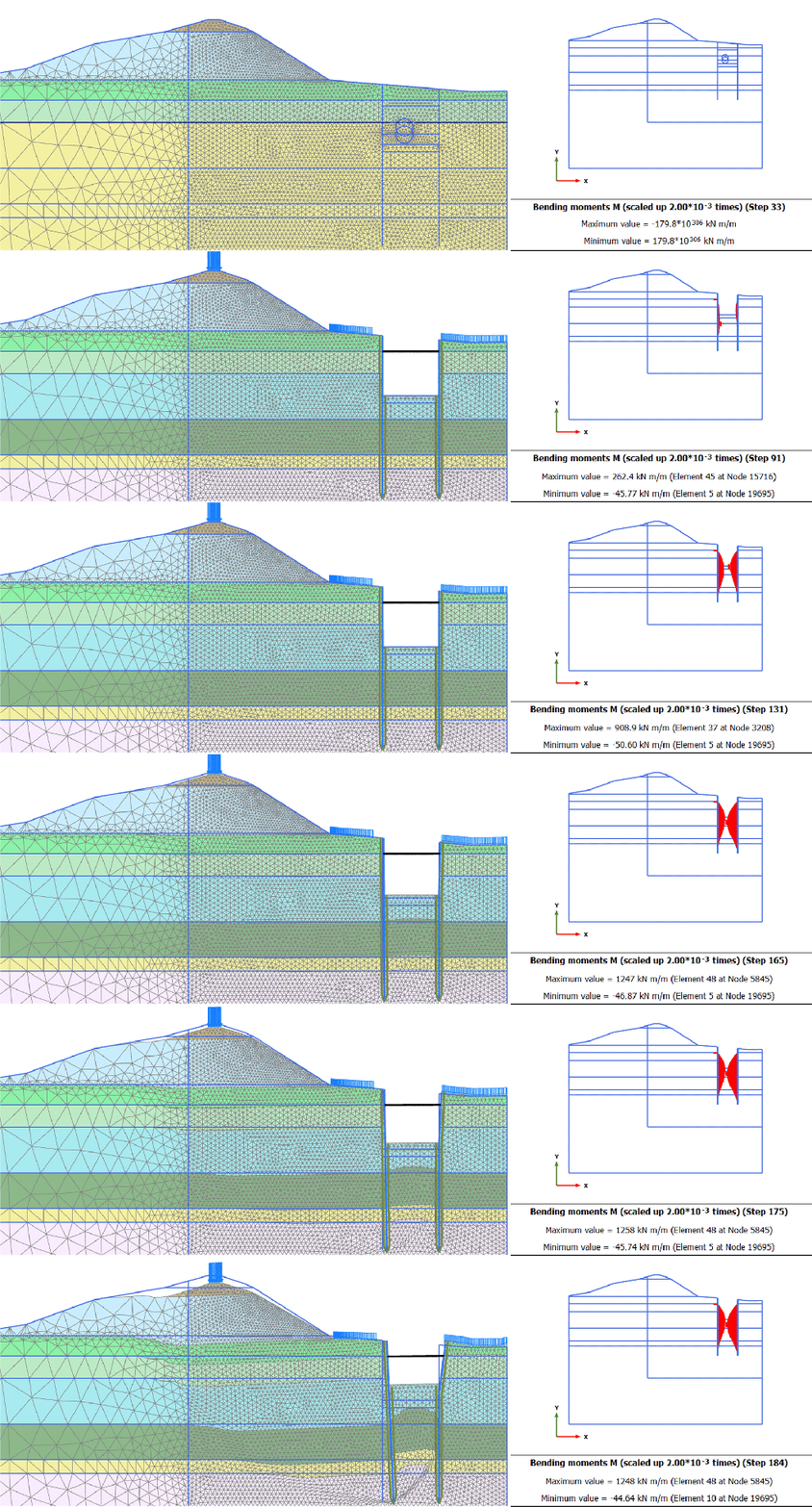
Nevertheless, DA3 also has limitations. When structural forces are derived from a reduced-strength state close to failure, the associated displacements may become very large. This can result in significant force redistribution and unrealistically high structural effects in the sheet pile wall and support system.
For this reason, a practical approach in some cases may be to use DA3 for the verification of overall stability, while adopting DA2 or DA2* for the structural design of the wall and support members, provided this is consistent with the applicable National Annex and project requirements.
However, when DA2* is used, the applied factors should be adjusted appropriately so that the resulting design effects reflect the required safety level for the relevant consequence class or reliability class.
In the example below, a 2D PLAXIS analysis of a sheet-pile-wall-supported excavation adjacent to a railway is presented. The global stability is only marginally above the required safety level. The left-hand side shows the progression of mesh deformation before and during the safety analysis, while the right-hand side shows how the bending moment in the sheet pile wall increases during the same analysis stages.
An elastic plate model is used so that the increase in bending moment is not artificially capped. If an elastoplastic plate had been selected instead, the bending moment would have been limited by the axial force–bending moment interaction envelope, and the analysis would not show the potential for further moment development.
In this example, the increase in bending moment stops only because the specified number of strength reduction steps, in this case 100, has been completed. If the safety analysis had been allowed to continue for additional steps, the bending moment would likely have continued to increase.
 ዝንቅ - Multidisciplinary Forum