
1. Introduction
Tipping, dumping, or accidental dropping of heavy masses can generate short-duration impact loads that produce local settlement and permanent ground deformation. Such effects may be critical where the impact occurs close to foundations, retaining walls, buried services, pavements, or other structures sensitive to ground movement.
A fully dynamic analysis of these events would require modelling contact behaviour, inertia, damping, stress-wave propagation, strain-rate effects, and the time-dependent response of the soil. For practical engineering assessment, however, an equivalent quasi-static approach may be appropriate where the primary design concern is residual settlement rather than transient vibration or peak impact force.
The proposed approach is based on an energy-balance principle. This principle is consistent with the treatment of dropped-object loading in DNV-RP-C204, where the impact is represented as a kinetic-energy problem. In that method, the impact energy is dissipated as strain energy in the impacted component and, where relevant, in the dropped object itself. The dissipated energy is evaluated from force–deformation relationships, with the absorbed energy corresponding to the area under the load–deformation curve.
In the present method, the same energy-balance concept is adapted to soil deformation. The kinetic energy of the falling or tipped mass is assumed to be converted into internal work in the soil, causing both elastic and plastic deformation. The method can be implemented in a finite element model by applying incremental loading over the assumed impact area and calculating the work done from the resulting load–deformation response.
2. Energy Basis
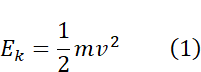
A mass m moving with velocity v at impact has kinetic energy:
For a freely falling mass from height h, neglecting air resistance and other losses, the impact velocity is:
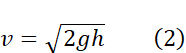
and therefore:

where g is gravitational acceleration.
During impact, the kinetic energy is dissipated as deformation work in the soil and, where relevant, in the impacting material or intermediate layers. The work done by the impact force is:

where F(δ) is the applied force as a function of deformation δ. For elastoplastic soil, this relationship is generally nonlinear. The work is therefore calculated as the area under the load–deformation curve, not simply as force multiplied by deformation.
For incremental FEM results, the accumulated work may be approximated as:
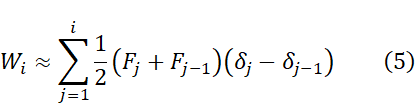
where F_j and δ_j are the applied load and corresponding deformation at increment j.
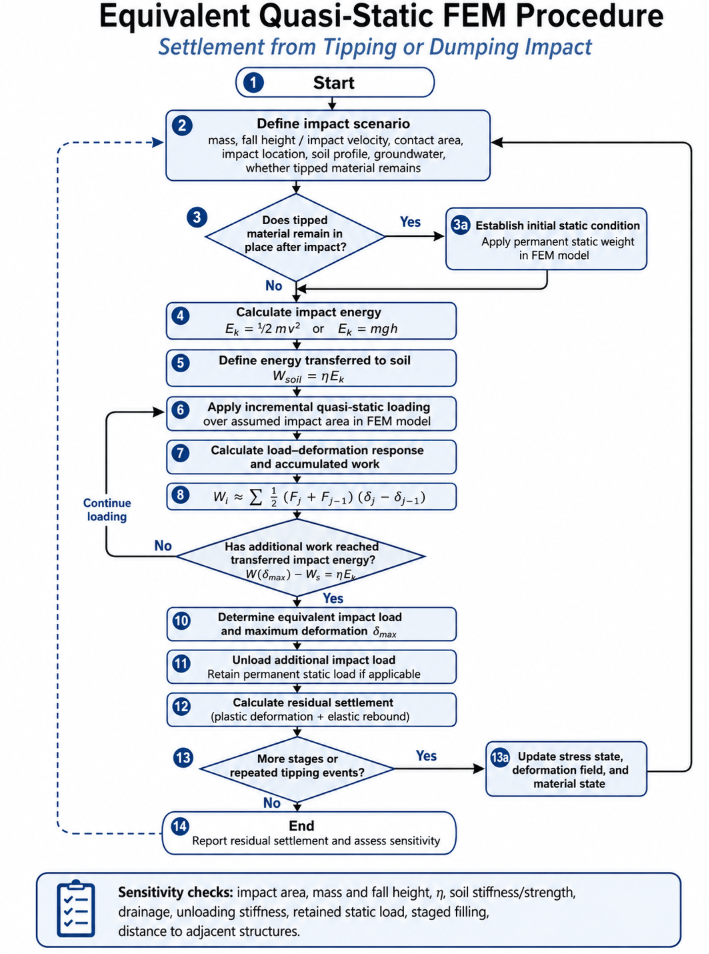
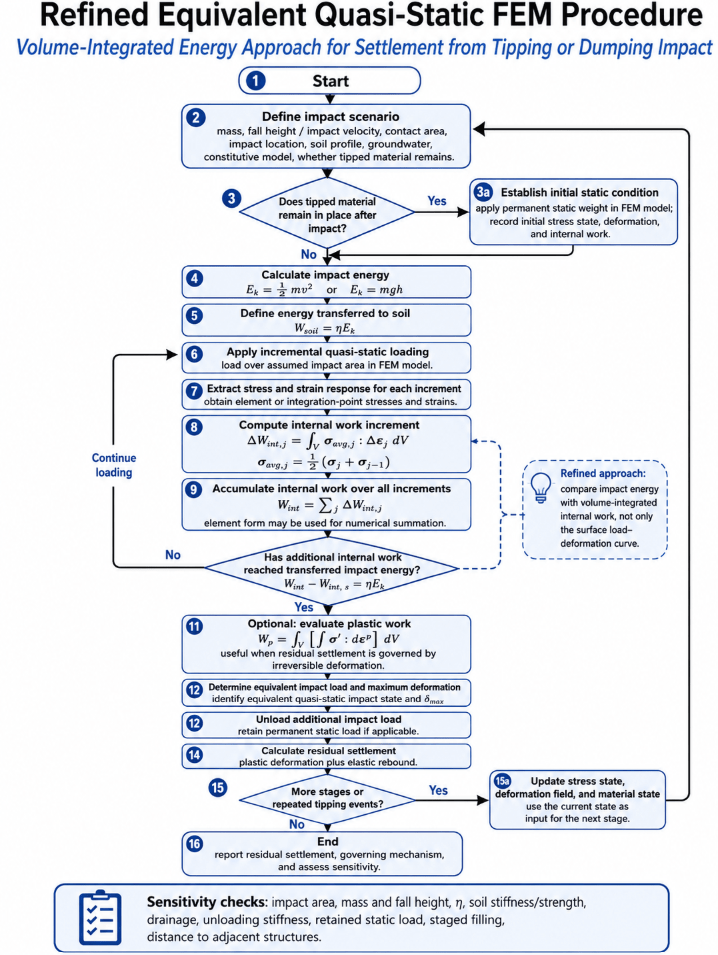
3. Proposed FEM Procedure
The following quasi-static FEM procedure may be adopted.
4. Extended Volume-Integrated Energy Approach
The load–deformation method evaluates external work at the load application point or over the assumed impact area. A more detailed approach is to evaluate the internal work accumulated throughout the deforming soil volume.
In a quasi-static FEM analysis, the external work calculated from the load–deformation curve and the internal work integrated over the model volume should be broadly consistent, provided that all relevant energy terms are included. However, the volume-integrated method gives additional insight into where the impact energy is dissipated. It can be used to identify whether the response is dominated by local bearing failure, deeper shear deformation, lateral spreading, or wider ground settlement.
5. Limitations
The method is approximate. It is an equivalent quasi-static approach, not as a full dynamic impact analysis. It does not explicitly model stress-wave propagation, inertia, damping, contact duration, strain-rate effects, or dynamic amplification. These effects may be important for large drop heights, stiff ground conditions, short impact durations, or sensitive nearby structures.
The result is also sensitive to the assumed contact area. In reality, the contact area may change during impact due to penetration, crushing, spreading, or rotation of the tipped material.
Soil behaviour is nonlinear and path-dependent. The calculated residual settlement depends on the soil constitutive model, drainage condition, stiffness degradation, plasticity model, and unloading stiffness. For saturated fine-grained soils, post-impact consolidation may also be relevant.
6. Recommended Sensitivity Checks
The following parameters should be varied to assess the robustness of the result:
- impact area;
- mass and fall height;
- energy transfer factor η;
- soil stiffness and strength;
- drainage condition;
- unloading stiffness;
- static load from retained tipped material;
- staged filling sequence;
- distance to adjacent structures.
Where adjacent structures are sensitive to vibration or transient movement, the quasi-static analysis should be supplemented by dynamic analysis, field monitoring, or empirical vibration assessment.
7. Conclusion
The proposed method provides a practical quasi-static FEM procedure for estimating soil settlement caused by tipping or dumping impacts. It is based on the same energy-balance principle used in established dropped-object and impact-assessment methods, where kinetic energy is converted into deformation work obtained from a load–deformation curve.
The method is useful where the main design concern is residual settlement. Its main advantages are simplicity, compatibility with conventional FEM analysis, and the ability to account for site-specific geometry, soil stratigraphy, boundary conditions, and staged loading.
However, the method does not capture the full dynamic impact response. It should therefore be applied with sensitivity analyses and, where consequences are significant, calibrated or checked against field observations, trial tipping, falling-weight tests, or dynamic numerical analysis.
 ዝንቅ - Multidisciplinary Forum