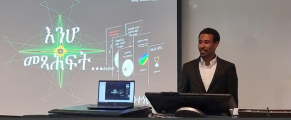
Kebede Michael formulated a story about three individuals with extraordinary knowledge. They set out to demonstrate their abilities to the king of the land. Along the way, they were joined by a commoner. During their journey, they encountered the scattered skeleton of a long-dead lion in a jungle. One of the knowledgeable individuals claimed he could reassemble the bones and, with a few muttered words, he did just that, fitting the skeleton pieces together perfectly. The second person asserted he could restore the body, and he succeeded, making the lion look like a fresh corpse. The third individual boasted he could bring the lion back to life.
The commoner, seeing where this was headed, protested. He said, “You three are very smart, but I am not. I am afraid the lion you are about to wake up will eat us all. I beg you not to proceed.” Despite his fears, the third man insisted, belittling the commoner. They mocked him, saying, “You think the lion we brought to life would harm us, you fool.” Realizing they would not be deterred, the commoner asked for one last favor: time to find a safe place. They agreed, and he climbed a nearby tree.
The third man muttered a few words and brought the lion back to life. Fully awake, hungry, and angry, the lion immediately leaped upon the person who revived him and devoured him. Terrified, the other two were frozen with fear. The lion then attacked the second man who had restored its body, killing and eating him as well. Satiated, the lion sought to secure more food for later. He killed the third man who had reassembled his skeleton and took him to his lair.
Watching from the tree, the commoner muttered, “A knife that is ultra sharp cuts through the sheath; ultra smartness can lead to death.”
You see…
Wise (ጠቢብ) and smart (ብልኅ) are entirely different. Wise sees wholly; smart divides, fragments and manipulates. The foundation of wisdom is love (ፍቅር); the foundation of smartness is the intellect. Smart continues to dissect even where the dissection can have dangerous consequences. Wisdom can use the intellect but can abandon it when it sees it as destructive. Wisdom sees a greater good; intellect sees a greater use. Smartness (ብልኅነት) can be ego-driven (ጠባያዊ); wisdom (ጥበብ) cannot. Wisdom is at ease; smartness requires effort. In these days, smartness is acclaimed, wisdom is not. Wise can see and understand smart, smart cannot fully grasp wisdom.


 ዝንቅ - Multidisciplinary Forum
Agreeing on the core argument of your text, I just wanted to add, clever/cunning, smart and wise are ብልጥ. ብልኅት ጠቢብ …
I think ብልጥ ብልጠት፣ አራዳ as in fooling others, or hiding information or telling lies to take advantage of others is bad.
Clever or cunning ብልጥ and አራዳ is mostly mischievous.
but ብልኅት Smart is finding a positive solution with honesty and openness.
Clever or cunning is ብልጠት፣ አራዳ፣ ፈታላ፣ divides, fragments and manipulates.
there is a one song which have this lyrics … Not While I’m Around Song by Stephen Sondheim … I saw it in TV series https://www.youtube.com/watch?v=-ex103kmbU8
being close and being clever
ain’t like being true,
This is the problem which I see mostly in Ethiopia, ብልጠት not smartness … I will write more later as it is taking me more time than I expected hahaha
LikeLike
Dear Saying Hi,
Smartness is of the intellect, which is focused and fragmented in its action. Its purpose is to achieve greater use and comfort. While “use” and “comfort” can be positive goals, this fragmented approach doesn’t guarantee a positive outcome because it doesn’t consider the whole picture. Many technological advancements exemplify the activities of the intellect, manipulating materials for greater use, often blind to the consequences. Cleverness or cunning represents a lower version of the intellect, and አራዳ and ፈታላ are even lower versions.
LikeLike