
Steel core piles are often regarded as the “Rolls-Royce” of foundation systems: they are highly capable, but also expensive, and their production and transportation come with a considerable carbon footprint. That alone makes optimal design not merely desirable, but necessary. Yet current practice is often far from optimal. In many cases, steel core piles are designed only for the elastic capacity of the steel core, while the contribution of the concrete infill and the steel casing is simply ignored. Structurally, this is difficult to justify. The pile is a composite member, and there is no fundamental reason why its resistance should not be assessed on that basis, particularly when corrosion losses in the casing can be accounted for explicitly, as is already done for steel pipe piles, and when the steel core can be detailed to ensure adequate interaction with the concrete.
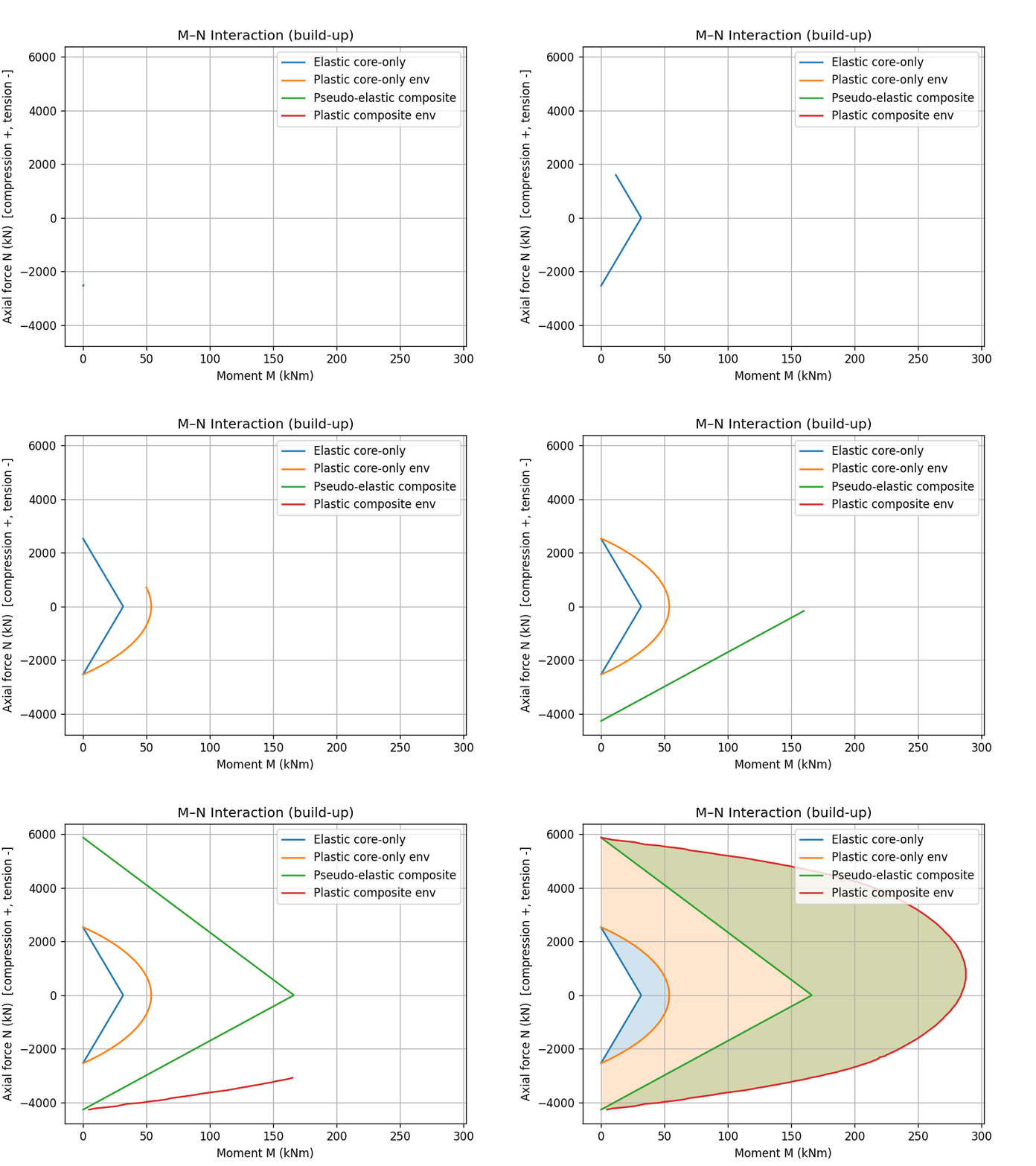
For some time, I have been reflecting on this inconsistency and about six years ago I developed a simplified method for estimating the capacity of steel core piles, which I refer to as the pseudo-elastic approach and would like to share here. The aim of the method is to provide a practical and reasonable estimate of composite pile capacity without requiring a full elasto-plastic section analysis. It builds on the relative simplicity of establishing the fully plastic capacity of the composite cross-section. The procedure begins by constructing the fully plastic M– interaction diagram of the pile, in which all materials in the cross-section are assumed to reach their plastic resistance. In this formulation, steel contributes in both tension and compression, the tensile resistance of concrete is neglected, and the effect of corrosion on the steel casing is taken into account through a reduced effective casing thickness.
Once this plastic capacity diagram has been established, the pseudo-elastic capacity is derived by calibrating an elastic-shaped composite interaction curve to the plastic composite response. First, the steel-only shape factor at zero axial force is determined as
This ratio expresses the relationship between the plastic and elastic moment capacities of the steel core alone. Next, the plastic composite moment resistance at zero axial force, , is obtained from the fully plastic composite interaction diagram. The pseudo-elastic composite moment resistance at zero axial force is then defined as
In this way, the pseudo-elastic composite curve is assigned the same plastic-to-elastic ratio at as the steel core alone. The axial intercepts of the pseudo-elastic curve are taken directly from the plastic composite interaction diagram, so that
The pseudo-elastic interaction is then defined piecewise by linear branches between these axial intercepts and the calibrated moment intercept at :
withThe result is a simplified composite interaction curve that preserves the axial capacity of the plastic composite solution while reducing its bending resistance to a level more consistent with an elastic design philosophy. The pseudo-elastic approach therefore provides a rational intermediate estimate: it is less conservative than designing for the elastic capacity of the steel core alone, yet less ambitious than adopting the full plastic capacity of the entire composite section. I further assume that the actual elasto-plastic capacity of the pile will lie between the pseudo-elastic and fully plastic capacities. On that basis, the pseudo-elastic model may be regarded as a better lower-bound approximation than the elastic capacity of the steel core alone, provided that the effects of corrosion, concrete strength, and the low tensile capacity of concrete are properly taken into account. As such, it offers a simple and transparent means of accounting for part of the beneficial contribution of both the concrete infill and the steel casing in practical design.
From a cost point of view, if the same design demand can be met with less steel, smaller sections, or fewer piles, then fabrication, transport, handling, and installation effort would usually fall as well. That is where the pseudo-elastic approach could support better optimization.
From a carbon-dioxide point of view, the argument is similar. A design that uses less steel and possibly fewer pile elements would generally reduce embodied emissions from:
- steel production,
- transport of heavy elements,
- site handling and installation,
- and potentially grout/concrete quantities as well.
So the environmental significance is that a less conservative but still cautious structural model can help avoid overdesign, and overdesign in steel foundations usually means unnecessary cost and unnecessary emissions.
However, the pseudo-elastic method is still a proposed engineering simplification, not a validated standard method. So the right conclusion is not “this guarantees savings,” but rather: it may offer a much better lower-bound design basis than elastic steel-core-only design, and that improved realism creates room for meaningful cost and carbon optimization where structural section capacity is the controlling criterion. Its use in practical design must therefore be regarded as exploratory, and any engineer choosing to apply it does so at their own risk.
 ዝንቅ - Multidisciplinary Forum